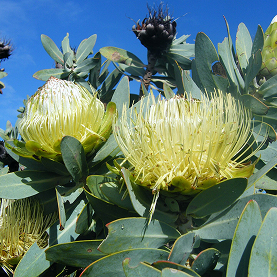
King protea
It is widely distributed in the fynbos region of South Africa, that is, in the southwestern and southern parts of Western Cape. The king protea is the national flower of South Africa.
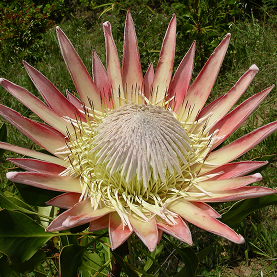
336 species
It is widely distributed in the fynbos region of South Africa, that is, in the southwestern and southern parts of Western Cape. The king protea is the national flower of South Africa.
Leucospermum, commonly known as pincushions, is a genus of evergreen upright, sometimes creeping shrubs that is assigned to the Proteaceae, with currently 48 known species.
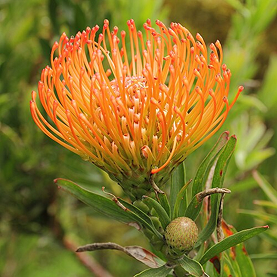
The plant grows on mountain slopes at altitudes of 400 to 900 metres. It prefers a fynbos habitat, and is found growing on granite-based or sandstone-based substrates.
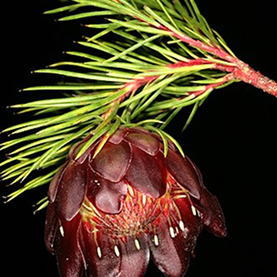
Its distribution is from the Kleinmond to Bredasdorp Mountains in South Africa and is one of the best known proteas in the cut flower industry. Its leaves curve upward.
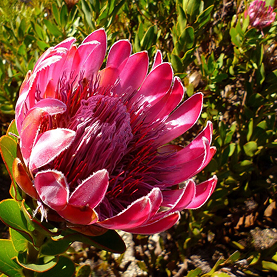
The plant is endemic to South Africa and is found from the Hottentots Holland Mountains across the Riviersonderend Mountains, the Kleinrivier Mountains and around the town of Caledon to the Swartberg mountains.
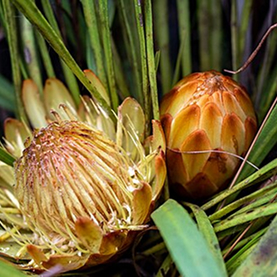
The name means "little trouble-maker", given with reference to the initial difficulties of placing V. latebrosa within the family.
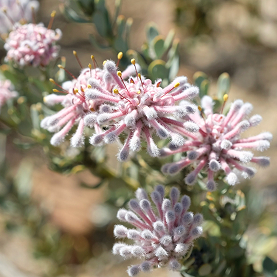
The shrub is large and erect, growing up to four metres in height. The leaves are quite broad. It blooms from the late summer to the early winter, from December to June, but mainly in the autumn from March to April.
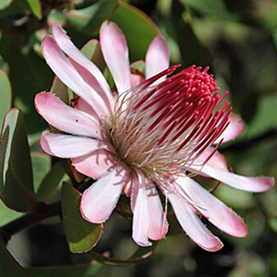
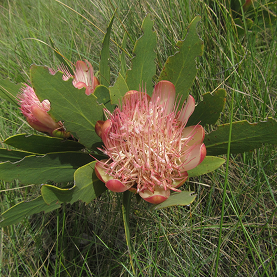
Protea dracomontana, the Nyanga protea or the Drakensberg sugarbush, is a flowering plant that belongs within the genus Protea. The plant is found in the Eastern Cape, Lesotho, KwaZulu-Natal and the escarpment of the Free State, as well as eastern Zimbabwe.
Protea nitida, commonly called wagon tree, waboom or blousuikerbos, is a large, slow-growing Protea endemic to South Africa. It is one of the few Protea species that grows into trees, and the only one that has usable timber.